Forms and operational tasks
Move through multi-step forms and routine data entry in the web applications your team uses. Keep business rules and completion checks in your code.
Automation
Put repetitive web tasks into repeatable workflows. Run your Playwright and Puppeteer scripts on real browsers with native graphics, human-like mouse and keyboard input, and the visibility to understand every run.
Built for Automation
Use browser code for tasks that require navigation, interaction, or a visual page rather than a single API request.
Move through multi-step forms and routine data entry in the web applications your team uses. Keep business rules and completion checks in your code.
Navigate dashboards and gather the information your workflow needs. Review the recording when a layout change or unexpected page state interrupts a run.
Run mobile web tasks on physical devices. Exercise the real mobile browser environment when a desktop profile does not match the workflow.
The Cloud Dev Tools difference
Browser access is more than an endpoint. These capabilities work together underneath your code, across AI agents, scraping, automation, and testing.
Automation libraries can leak objects that a website’s web application firewall detects. Our own firewall sits between libraries such as Puppeteer and Playwright and the browser to prevent those detectable object leaks.
Your library → CDT firewall → Browser
Every browser instance has a native GPU for hardware rendering. WebGL, canvas, video, and page composition use real graphics hardware, with actual consumer CPU and RAM values reported in JavaScript.
Consumer CPU · Real RAM · Native GPU
Run desktop browsers on consumer hardware or choose physical mobile devices. Mobile sessions use an actual mobile browser environment rather than desktop emulation with a smaller viewport.
Real desktop hardware · Physical mobile
Choose datacenter, residential, or mobile proxies, city-level targeting, or bring your own proxy. The API’s domain-based routing keyword helps automatically select an appropriate proxy for your target website.
Domain-based routing · Flexible proxies
We run regular browsers and keep them up to date. TLS and protocol handshake parameters come from the browser itself, without tying your workflow to an older browser binary bundled with an automation library.
Up-to-date browsers · Native protocols
Mouse and keyboard events execute at the system level, through the same input path as real peripherals. Movements and keystrokes mimic human behavior instead of relying only on synthetic page events.
System-level mouse · System-level keyboard
From code to browser
Use Playwright or Puppeteer with a managed browser endpoint. Start with the connection details in the API documentation.
Read the integration documentationRun your application or scheduled job wherever you already host it. Connect to a remote browser instead of maintaining browser hardware yourself.
Use current desktop browsers or physical mobile devices, with a GPU in every instance and proxy options for the destination.
Follow a live session and inspect searchable history and recordings. Develop and try supported-language code directly in the portal.
From development to investigation
The browser is only half the workflow. Develop in the portal, follow active sessions, and return to the evidence when something needs a closer look.
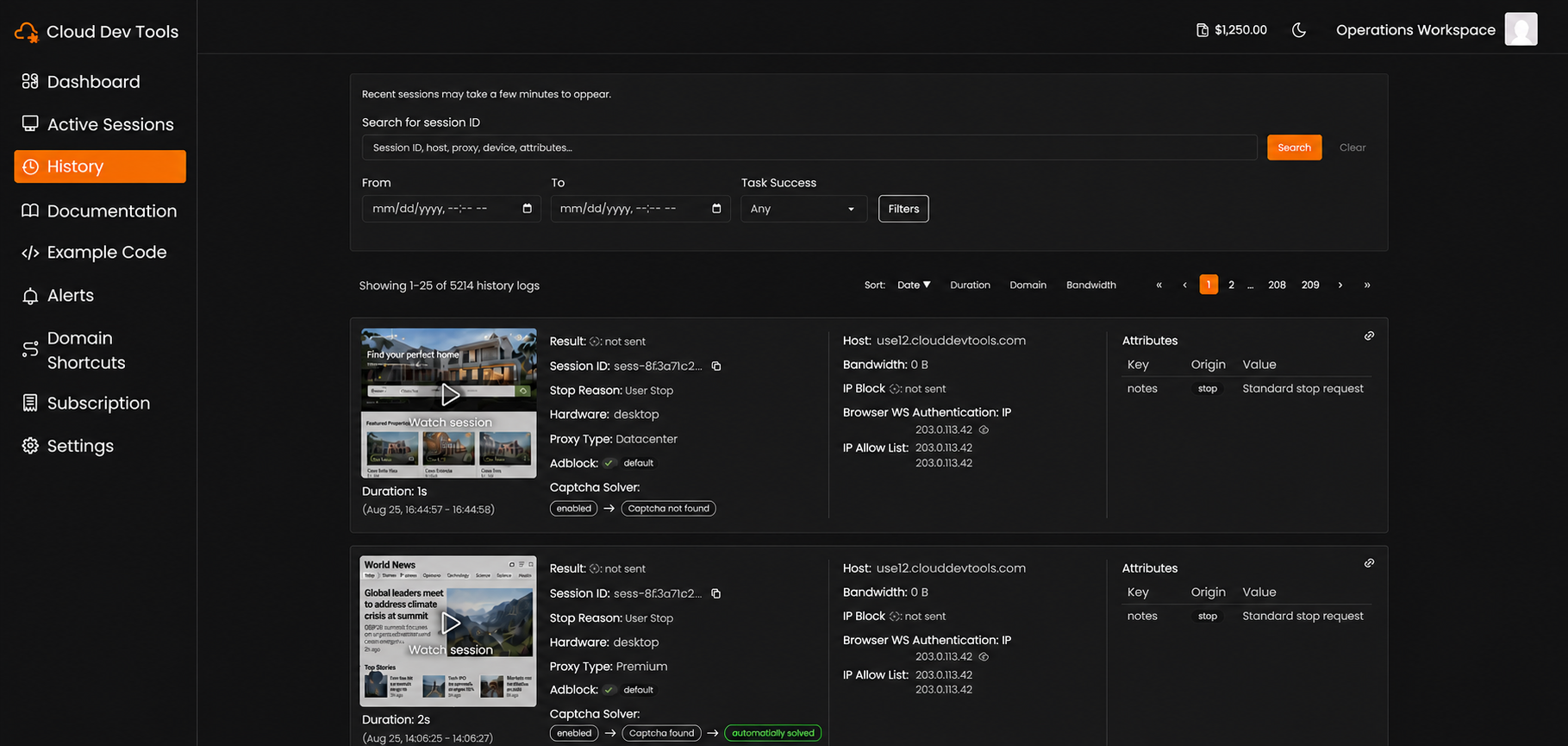
Let people and AI agents follow the browser as a workflow runs.
Find past sessions, inspect detailed logs, and review clear recordings.
Write and run tests in supported languages without local IDE or environment setup.
Use local AI models to help resolve difficult CAPTCHA challenges during a session.
Common questions
Your application can run the Playwright or Puppeteer client in your own environment and connect to a Cloud Dev Tools browser endpoint. The portal also lets you write and run tests in supported languages.
Mouse and keyboard events execute through system-level input paths, with movement and keystrokes designed to mimic human interaction.
Watch the live session, search past runs, inspect detailed logs, and replay the recording to see which page or action needs attention.
A complete browser foundation